Question 2 Options the Two Types of Arches Most Associated With Islamic Art
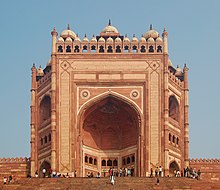
Indo-Islamic architecture is the architecture of the Indian subcontinent produced by and for Islamic patrons and purposes. Despite an initial Arab presence in Sindh, the evolution of Indo-Islamic architecture began in earnest with the establishment of Delhi every bit the capital of the Ghurid dynasty in 1193.[1] Succeeding the Ghurids was the Delhi Sultanate, a series of Central Asian dynasties that consolidated much of North Republic of india, and later the Mughal Empire by the 15th century. Both of these dynasties introduced Persianate architecture and art styles from Western Eurasia into the Indian subcontinent.[2]
The types and forms of large buildings required by Muslim elites, with mosques and tombs much the most common, were very dissimilar from those previously congenital in India. The exteriors of both were very oft topped by large domes, and made extensive apply of arches. Both of these features were hardly used in Hindu temple compages and other indigenous Indian styles. Both types of building essentially consist of a single large space nether a loftier dome, and completely avert the figurative sculpture so important to Hindu temple architecture.[3]
Islamic buildings initially adapted the skills of a workforce trained in earlier Indian traditions to their own designs. Unlike most of the Islamic world, where brick tended to predominate, India had highly skilled builders well used to producing stone masonry of extremely loftier quality.[4] Alongside the architecture adult in Delhi and prominent centres of Mughal culture such as Agra, Lahore and Allahabad, a variety of regional styles developed in regional kingdoms like the Bengal, Gujarat, Deccan, Jaunpur and Kashmir Sultanates. By the Mughal period, generally agreed to represent the peak of the fashion, aspects of Islamic style began to influence architecture made for Hindus, with even temples using scalloped arches, and later domes. This was peculiarly the example in palace compages. Following the collapse of the Mughal Empire, regional nawabs such every bit in Lucknow, Hyderabad and Mysore continued to commission and patronize the construction of Mughal-style compages in the princely states.
Indo-Islamic architecture has left a large impact on modern Indian, Pakistani and Bangladeshi architecture, as in the case of its influence on the Indo-Saracenic Revivalism of the late British Raj. Both secular and religious buildings are influenced by Indo-Islamic architecture.
Compages of the Delhi Sultanate [edit]
The best-preserved case of a mosque from the days of the infancy of Islam in South asia is the ruined mosque at Banbhore in Sindh, Pakistan, from the year 727, from which only the plan tin can be deduced.[five]
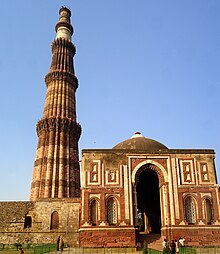
The start of the Delhi Sultanate in 1206 under Qutb al-Din Aibak introduced a large Islamic state to India, using Central Asian styles.[half-dozen] The of import Qutb Complex in Delhi was begun under Muhammad of Ghor, by 1199, and connected nether Qutb al-Din Aibak and subsequently sultans. The Quwwat-ul-Islam Mosque, now a ruin, was the start structure. Like other early Islamic buildings it re-used elements such equally columns from destroyed Hindu and Jain temples, including ane on the same site whose platform was reused. The style was Iranian, but the arches were still corbelled in the traditional Indian way.[7]
Abreast it is the extremely tall Qutb Minar, a minaret or victory tower, whose original four stages reach 73 meters (with a final stage added later). Its closest comparator is the 62-metre all-brick Minaret of Jam in Afghanistan, of c.1190, a decade or so earlier the probable start of the Delhi tower.[8] The surfaces of both are elaborately decorated with inscriptions and geometric patterns; in Delhi the shaft is fluted with "superb stalactite bracketing under the balconies" at the summit of each stage.[9] In full general minarets were boring to be used in India, and are often discrete from the master mosque where they be.[10]

The Tomb of Iltutmish was added by 1236; its dome, the squinches once more corbelled, is now missing, and the intricate carving has been described as having an "angular harshness", from carvers working in an unfamiliar tradition.[xi] Other elements were added to the circuitous over the next two centuries.
Another very early mosque, begun in the 1190s, is the Adhai Din Ka Jhonpra in Ajmer, Rajasthan, congenital for the same Delhi rulers, again with corbelled arches and domes. Here Hindu temple columns (and perchance some new ones) are piled upward in threes to accomplish extra acme. Both mosques had large discrete screens with pointed corbelled arches added in front of them, probably under Iltutmish a couple of decades later. In these the primal arch is taller, in fake of an iwan. At Ajmer the smaller screen arches are tentatively cusped, for the first fourth dimension in India.[12]
Past effectually 1300 truthful domes and arches with voussoirs were being built; the ruined Tomb of Balban (d. 1287) in Delhi may be the primeval survival.[13] The Alai Darwaza gatehouse at the Qutb circuitous, from 1311, yet shows a cautious approach to the new engineering science, with very thick walls and a shallow dome, simply visible from a certain altitude or peak. Bold contrasting colours of masonry, with ruby-red sandstone and white marble, introduce what was to become a mutual feature of Indo-Islamic architecture, substituting for the polychrome tiles used in Persia and Central Asia. The pointed arches come together slightly at their base, giving a mild horseshoe curvation effect, and their internal edges are not cusped but lined with conventionalized "spearhead" projections, perchance representing lotus buds. Jali, stone openwork screens, are introduced here; they already had been long used in temples.[14]
Tughlaq compages [edit]
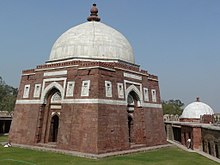
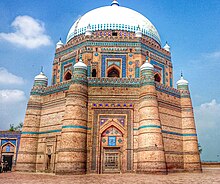
The tomb of Shah Rukn-eastward-Alam (built 1320 to 1324) in Multan, Pakistan is a large octagonal brick-congenital mausoleum with polychrome glazed decoration that remains much closer to the styles of Iran and Transitional islamic state of afghanistan. Timber is also used internally. This was the earliest major monument of the Tughlaq dynasty (1320–1413), built during the unsustainable expansion of its massive territory. It was built for a Sufi saint rather than a sultan, and most of the many Tughlaq tombs are much less exuberant. The tomb of the founder of the dynasty, Ghiyath al-Din Tughluq (d. 1325) is more ascetic, merely impressive; like a Hindu temple, information technology is topped with a small amalaka and a circular finial similar a kalasha. Unlike the buildings mentioned previously, it completely lacks carved texts, and sits in a chemical compound with high walls and battlements. Both these tombs take external walls sloping slightly inwards, past 25° in the Delhi tomb, like many fortifications including the ruined Tughlaqabad Fort opposite the tomb, intended as the new capital.[15]
The Tughlaqs had a corps of government architects and builders, and in this and other roles employed many Hindus. They left many buildings, and a standardized dynastic style.[16] The third sultan, Firuz Shah (r. 1351-88) is said to have designed buildings himself, and was the longest ruler and greatest architect of the dynasty. His Firoz Shah Palace Circuitous (started 1354) at Hisar, Haryana is a ruin, only parts are in fair status.[17] Some buildings from his reign accept forms that had been rare or unknown in Islamic buildings.[eighteen] He was buried in the big Hauz Khas Complex in Delhi, with many other buildings from his menses and the later Sultanate, including several small domed pavilions supported but past columns.[19]
By this time Islamic architecture in India had adopted some features of earlier Indian architecture, such as the use of a high plinth,[20] and frequently mouldings around its edges, also as columns and brackets and hypostyle halls.[21] Afterwards the death of Firoz the Tughlaqs declined, and the following Delhi dynasties were weak. Near of the awe-inspiring buildings synthetic were tombs, although the impressive Lodi Gardens in Delhi (adorned with fountains, charbagh gardens, ponds, tombs and mosques) were constructed by the belatedly Lodi dynasty. The architecture of other regional Muslim states was ofttimes more than impressive.[22]
-

Possibly the first "true" arches in India; Tomb of Balban (d. 1287) in Delhi
Pre-Mughal regional architecture [edit]
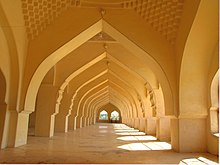
Arches in the main mosque at Gulbarga, 1367
Significant regional styles developed in the contained sultanates formed when the Tughlaq empire weakened in the mid-14th century, and lasted until most were absorbed into the Mughal Empire in the 16th century. The sultanates of the Deccan Plateau, Gujarat, Bengal and Kashmir are discussed below. The compages of the Malwa and Jaunpur sultanates has too left some meaning buildings.[23]
Deccan sultanates [edit]
The Bahmani Sultanate in the Deccan bankrupt away from the Tughlaqs in 1347, and ruled from Gulbarga, Karnataka and and then Bidar until overrun by the Mughals in 1527. The chief mosque (1367) in the large Gulbarga Fort or citadel is unusual in having no courtyard. There are a total of 75 domes, all small and shallow and small except for a large one above the mihrab and four bottom ones at the corners. The large interior has a central hypostyle infinite, and wide aisles with "transverse" arches springing from unusually low down (illustrated). This distinctive feature is establish in other Bahmanid buildings, and probably reflects Iranian influence, which is seen in other features such every bit a four-iwan program and glazed tiles, some actually imported from Islamic republic of iran, used elsewhere. The architect of the mosque is said to have been Farsi.[24]
Some later Bahminid royal tombs are double, with two units of the usual rectangle-with-dome class combined, ane for the ruler and the other for his family,[25] as at the Haft Dombad ("Vii Domes") group of imperial tombs outside Gulbarga. The Mahmud Gawan Madrasa (begun 1460s) is a large ruined madrasa "of wholly Iranian blueprint" in Bidar founded by a chief minister, with parts busy in glazed tiles imported past sea from Islamic republic of iran.[26] Outside the city the Ashtur tombs are a group of eight large domed royal tombs. These take domes which are slightly pulled in at the base,[27] predating the onion domes of Mughal architecture.
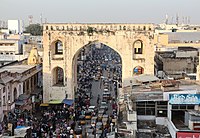
The Qutb Shahi dynasty of Hyderabad, not captivated past the mughals until 1687, profoundly developed the city and its surrounding region, building many mosques such every bit the Mecca Masjid, Khairtabad Mosque, Hayat Bakshi Mosque and Toli Mosque, also every bit the Golconda Fort, tombs of the Qutb Shahis, Charminar, Char Kaman and Taramati Baradari.
-

A row of Bahminid tombs at Ashtur, Bidar
-

-
-

-

Bengal Sultanate [edit]

The Bengal Sultanate (1352–1576) normally used brick equally the master structure cloth of large buildings, as pre-Islamic buildings had done.[28] Stone had to be imported to nearly of Bengal, whereas clay for bricks is plentiful. Just stone was used for columns and prominent details, usually re-used from Hindu or Buddhist temples.[29] The early 15th century Eklakhi Mausoleum at Pandua, Malda or Adina, is often taken to be the primeval surviving foursquare single-domed Islamic building in Bengal, the standard grade of smaller mosques and mausoleums. But there is a small mosque at Molla Simla, Hooghly district, that is possibly from 1375, before than the mausoleum.[30] The Eklakhi Mausoleum is large and has several features that were to become mutual in the Bengal style, including a slightly curved cornice, large round decorative buttresses at the corners, and decoration in carved terracotta brick.[31]
These features are likewise seen in the Choto Sona Mosque (around 1500), which is in stone, unusually for Bengal, merely shares the fashion and mixes domes and a curving "paddy" roof based on hamlet house roofs made of vegetable thatch. Such roofs feature even more strongly in later on Bengal Hindu temple architecture, with types such equally the practice-chala, jor-bangla, and char-chala.[32] For larger mosques, Bengali architects multiplied the numbers of domes, with a nine-domed formula (3 rows of three) existence i option, surviving in four examples, all 15th or 16th century and now in Bangladesh,[33] although there were others with larger numbers of domes.[34]
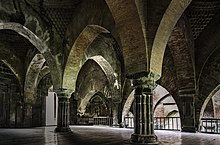
Buildings in the way are the Nine Dome Mosque and the Sixty Dome Mosque (completed 1459) and several other buildings in the Mosque Metropolis of Bagerhat, an abased urban center in People's republic of bangladesh now featured as a UNESCO Globe Heritage Site. These show other distinctive features, such every bit a multiplicity of doors and mihrabsouthward; the 60 Dome Mosque has 26 doors (11 at the front, vii on each side, and one in the rear). These increased the light and ventilation. Farther mosques include the Baro Shona Masjid; the Pathrail Mosque, the Bagha Mosque, the Darasbari Mosque, and the Kusumba Mosque. Single-domed mosques include the Singar Mosque, and the Shankarpasha Shahi Masjid.
Both capitals of the Bengal Sultanate, commencement Pandua or Adina, and then from 1450 Gauda or Gaur, started to be abandoned soon later on the conquest of the sultanate by the Mughals in 1576, leaving many g buildings, more often than not religious. The materials from secular buildings were recycled by builders in after periods.[35] While minarets are conspicuously absent in most mosques, the Firoz Minar was built in Gauda to commemorate Bengali military victories.
The ruined Adina Mosque (1374–75) is very big, which is unusual in Bengal, with a barrel vaulted fundamental hall flanked by hypostyle areas. It is said to exist the largest mosque in the sub-continent, and modeled after the Ayvan-e Kasra of Ctesiphon, Iraq, likewise as the Umayyad Mosque of Damascus.[36] The heavy rainfall in Bengal necessitated large roofed spaces, and the nine-domed mosque, which immune a large area to be covered, was more popular in that location than anywhere else.[37] After the Islamic consolidation of Bengal was complete, some local features connected, peculiarly in smaller buildings, but the Mughals used their usual fashion in imperial commissions.[38]
-
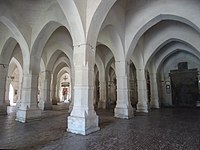
Interior of the Shat Gambuj Mosque
-
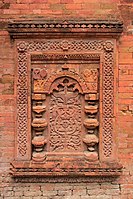
Terracotta arabesque on the wall of Khania Dighi Mosque, Gauda, 15th-century
-
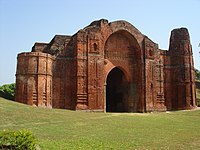
Dakhil Doorway, Gauda, 16th-century
Indo-Islamic compages of Gujarat [edit]

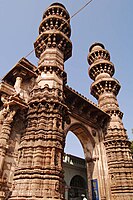
The distinctive Indo-Islamic architecture style of Gujarat drew micro-architectural elements from before Maru-Gurjara architecture and employed them in mihrab, roofs, doors, minarets and facades.[39] In the 15th century, the Indo-Islamic way of Gujarat is particularly notable for its inventive and elegant use of minarets. They are oftentimes in pairs flanking the primary archway, by and large rather sparse and with elaborate carving at least at the lower levels. Some designs push button out balconies at intervals upward the shaft; the most farthermost version of this was in the lost upper parts of the so-called "shaking minarets" at the Jama Mosque, Ahmedabad,[twoscore] which fell down in an earthquake in 1819. This carving draws on the traditional skills of local stone-carvers, previously exercised on Hindu temples in the Māru-Gurjara and other local styles.[41]
Under the Gujarat Sultanate, contained betwixt 1407 and 1543, Gujarat was a prosperous regional sultanate under the dominion of the Muzaffarid dynasty, who built lavishly, particularly in the capital, Ahmedabad.[42] The sultanate commissioned mosques such as the Jami Masjid of Ahmedabad, Jama Masjid at Champaner, Jami Masjid at Khambhat, Qutbuddin Mosque, Rani Rupamati Mosque, Sarkhej Roza, Sidi Bashir Mosque, Kevada Mosque, Sidi Sayyed Mosque, Nagina Mosque and Pattharwali Masjid, as well equally structures such every bit Teen Darwaza, Bhadra Fort and the Dada Harir Stepwell in Ahmedabad.
The Champaner-Pavagadh Archaeological Park, the 16th century uppercase of Gujarat Sultanate, documents the early on Islamic and pre-Mughal city that has remained without whatever change.[43]
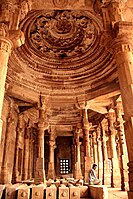
Indo-Islamic compages mode of Gujarat presages many of the architectural elements later found in Mughal architecture, including ornate mihrabs and minarets, jali (perforated screens carved in stone), and chattris (pavilions topped with cupolas).



Kashmir [edit]
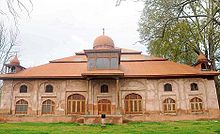
By 1339, Shams-ud-din Shah Mir of the Shah Mir dynasty established a sultanate encompassing the region of Kashmir (consisting of modern-day Gilgit-Baltistan, Azad Kashmir, Jammu and Kashmir, Ladakh, and Aksai Mentum), allowing for the gradual Islamization of the region and the hybridization of Persianate civilization and architecture with the indigenous Buddhist styles of Kashmir.
In the capital at Srinagar in modern Indian-administered Kashmir, Sikandar Shah Mir (died 1413) constructed the Jamia Masjid, a large wooden congregational mosque that incorporates elements of Buddhist pagoda construction, besides as the wooden Khanqah-e-Moulah mosque. As well in Srinagar are the Aali Masjid and the Tomb of Zain-ul-Abidin. Two 14th-century wooden mosques in Gilgit-Baltistan are the Chaqchan Mosque in Khaplu (1370) and the Amburiq Mosque in Shigar. Both accept stone-built cores with elaborately carved wooden exterior galleries, at Amburiq on ii levels, in an adaptation of traditional local styles.
-

Jamia Masjid in Srinagar, Kashmir.
-

Interior of the Jamia Masjid.
-

Khanqah-east-Moula in Srinagar, Kashmir
-
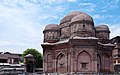
Tomb of Zain-ul-Abedin's female parent in Srinagar, Kashmir.
-

Chaqchan Mosque in Khaplu, Gilgit-Baltistan
-

Amburiq Mosque in Gilgit-Baltistan.
Mughal compages [edit]
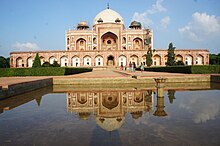
The Mughal Empire, an Islamic empire that lasted in India from 1526 to 1857 left a mark on Indian architecture that was a mix of Islamic, Western farsi, Arabic, Central Asian and native Indian architecture. A major aspect of Mughal compages is the symmetrical nature of buildings and courtyards. Akbar, who ruled in the 16th century, fabricated major contributions to Mughal compages. He systematically designed forts and towns in similar symmetrical styles that blended Indian styles with outside influences. The gate of a fort Akbar designed at Agra exhibits the Assyrian gryphon, Indian elephants, and birds.[44]

During the Mughal era design elements of Islamic-Persian architecture were fused with and often produced playful forms of the Hindustani art. Lahore, occasional residence of Mughal rulers, exhibits a multiplicity of of import buildings from the empire, among them the Badshahi mosque (built 1673-1674), the fortress of Lahore (16th and 17th centuries) with the famous Alamgiri Gate, the colourful Wazir Khan Mosque,[45] (Lahore, 1634-1635) besides every bit numerous other mosques and mausoleums. The Shahjahan Mosque at Thatta, Sindh was built under, and probably largely by Shah Jahan, but strongly reflects Primal Asian Islamic mode, as the emperor had recently been campaigning near Samarkand. Singularly, the innumerable Chaukhandi tombs are of eastern influence. Although constructed between 16th and 18th centuries, they do not possess any similarity to Mughal compages. The stonemason works bear witness rather typical Sindhi workmanship, probably from before Islamic times.
Later Mughal architecture, built under Aurangzeb (ruled 1658–1707), include the Badshahi Mosque in Lahore and Bibi ka Maqbara in Aurangabad. By the late 18th century the way was effectively over. However, by this fourth dimension versions of Mughal style, often called "postal service-Mughal", had been widely adopted past the rulers of the princely states and other wealthy people of all religions for their palaces and, where appropriate, tombs. Hindu patrons oftentimes mixed aspects of Hindu temple compages and traditional Hindu palace architecture with Mughal elements and, later, European ones.[46]
Major examples of Mughal compages include:
- Tombs: Taj Mahal, Akbar'south Tomb, Bibi ka Maqbara, Safdarjung Tomb and Humayun's Tomb
- Forts: Red Fort, Lahore Fort, Agra Fort and Idrakpur Fort
- Mosques: Jama Masjid of Delhi, Badshahi Masjid and Moti Masjid
- Gardens: Shalimar Gardens, Bagh-e-Babur and Verinag Garden
- Caravansaries: Akbari Sarai and Bara Katra
- Bridges: Shahi Bridge, Mughal Bridge, Athpullah and Barapullah
- Milemarkers: Kos Minar
-
-
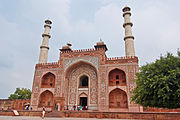
Akbar's Tomb at Agra, India uses red sandstone and white marble, like many of the Mughal monuments. The Taj Mahal is a notable exception, as it uses merely marble.
-

-

Shalimar Garden in Lahore, Pakistan
Taj Mahal [edit]
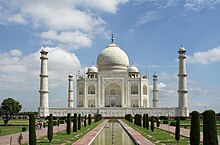
The Taj Mahal in Agra, India, widely considered the pinnacle of Islamic architecture in the subcontinent.
The nigh well known example of Mughal architecture is the Taj Mahal. It was built for the wife of Shah Jahan, who died in 1631. The chief ideas and themes of garden tombs had already been explored by before Mughal emperors, and this was the culmination of all those previous works into a national landmark. The 171 meter white tomb rises to a higher place a reflecting pool.
Scarlet Fort [edit]
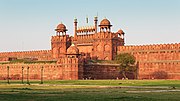
The Red Fort in Delhi is also an important example of Mughal Compages. Information technology was congenital during the zenith of the Mughal Empire under Shah Jahan. It was designated a UNESCO World Heritage Site in 2007. Every bit ane of the largest forts in Bharat, it served as the official residence of the emperor for nearly 200 years.
Post-Mughal Islamic compages [edit]

Following the plummet of the Mughal Empire after the Mughal-Maratha Wars, the emergence of the Sikh Empire and the invasions of Nader Shah, Ahmad Shah Durrani and the British Eastward Bharat Company, prosperous provinces of the Mughal Empire such as Awadh, Bengal, Hyderabad and Mysore emerged as powerful regional states independent of Delhi.
In Awadh (encompassing modern eastern Uttar Pradesh), Lucknow emerged as a centre of Ganga-Jamuni culture and Urdu/Hindustani literature. The Nawabs of Awadh sponsored the construction of architectural masterpieces such every bit Bara Imambara, Rumi Darwaza, Chota Imambara, Sikandar Bagh and Ghantaghar in Lucknow, as well as Gulab Bari and Bahu Begum ka Maqbara in Faizabad.
In Hyderabad, the Asaf Jahi dynasty became exceedingly wealthy and were one of the richest royal families in the globe by the mid-20th century. The Nizam commissioned construction of various public works and buildings in their state (oft in Indo-Saracenic and Mughal style) such as the Telangana High Court, City Higher, Public Gardens, (formerly Bagh-eastward-Aaam), Jubilee Hall, Asafia Library, The Assembly building, Niloufer Infirmary, the Osmania Arts College and Osmania Medical Higher, as well as palaces similar Hyderabad House and Chowmahalla Palace.
The then-called Indo-Saracenic architecture, offset in the late 18th century, simply mainly developing from the 1840s until independence a century later, was mostly designed by British or other European architects, and adopted Islamic or specifically Indian features, unremarkably as a decorative pare on buildings whose essential forms reflected gimmicky Western types and uses, whether as office buildings, palaces, courts of justice, railway stations or hotels. The manner, which is very variable, thus became one of a number of revival architecture styles that were available to the Victorian builder. The usual type of Indian architecture borrowed from was Mughal compages, or its Rajput palace version.
See as well [edit]
- Architecture of the Deccan sultanates
- Architecture of Bharat
- Pakistani compages
- Architecture of Bangladesh
- History of domes in South asia
- Compages of Bengal
Notes [edit]
- ^ Harle, 423-424
- ^ Yale, 164-165
- ^ Harle, 421, 425; Yale, 165; Blair & Bloom, 149
- ^ Harle, 424; Yale, 165
- ^ Port of Banbhore, UNESCO Tentative list; Yale, 28-29
- ^ Harle, 423-424
- ^ Yale, 164-165; Harle, 423-424; Blair & Bloom, 149
- ^ Also ii huge minarets at Ghazni.
- ^ Yale, 164; Harle, 424 (quoted); Blair & Blossom, 149
- ^ Harle, 429
- ^ Yale, 164 (quoted); Harle, 425
- ^ Blair & Bloom, 149-150; Harle, 425
- ^ Harle, 425
- ^ Blair & Bloom, 151
- ^ Blair & Flower, 151-156; Harle, 425-426
- ^ Blair & Flower, 151
- ^ Blair & Bloom, 154; Harle, 425
- ^ Blair & Flower, 154-156
- ^ Blair & Bloom, 154-156; Harle, 425
- ^ Blair & Bloom, 149
- ^ Blair & Bloom, 156
- ^ Harle, 426; Blair & Bloom, 156
- ^ Harle, 431-432
- ^ Blair & Bloom, 156; Harle, 433
- ^ Harle, 433
- ^ Harle, 433
- ^ Harle, 433
- ^ Banglapedia
- ^ Brown, XXIX; Hasan, 34-35; Harle, 428
- ^ Hasan, 35-39
- ^ Hasan, 36-37; Harle, 428
- ^ Hasan, 23-25
- ^ Hasan, 41-44
- ^ Hasan, 44-49
- ^ Banglapedia
- ^ "BENGAL – Encyclopaedia Iranica". world wide web.iranicaonline.org . Retrieved 2019-07-15 .
- ^ Hasan, 35-36, 39
- ^ Banglapedia
- ^ LAMBOURN, ELIZABETH A. (2010). "A Self-Conscious Fine art? SEEING MICRO-ARCHITECTURE IN SULTANATE South asia". Muqarnas. 27: 121–156. ISSN 0732-2992.
- ^ "The Shaking Minarets at Ahmedabad, drawn in 1809", British Library
- ^ Harle, 429-430
- ^ Middle, UNESCO Globe Heritage. "Historic City of Ahmadabad". UNESCO World Heritage Centre. Archived from the original on 2019-09-03. Retrieved 2019-09-26 .
- ^ "Champaner-Pavagadh". Worldheritagesite.org. Archived from the original on 6 October 2012. Retrieved 23 September 2012.
- ^ Lewis, Bernard (2002). The Earth of Islam . Thames and Hudson, Ltd. pp. 306. ISBN0-500-27624-2.
- ^ Simon Ross Valentine. 'Islam and the Ahmadiyya Jama'at: History, Conventionalities, Practice Hurst Publishers, 2008 ISBN 1850659168 p 63
- ^ Harle, 443-444
References [edit]
- "Banglapedia": "Compages" in Banglapedia
- Blair, Sheila, and Flower, Jonathan Yard., The Fine art and Architecture of Islam, 1250-1800, 1995, Yale University Press Pelican History of Art, ISBN 0300064659
- Brown, Percy, Indian Architecture (The Islamic Period), 2013 (reprint, 1940 1st edn.), Read Books, ISBN 9781447494829, google books
- Harle, J.C., The Art and Architecture of the Indian Subcontinent, 2nd edn. 1994, Yale Academy Printing Pelican History of Fine art, ISBN 0300062176
- Hasan, Perween, Sultans and Mosques: The Early on Muslim Architecture of Bangladesh, 2007, I.B.Tauris, ISBN 1845113810, 9781845113810, google books
- "Yale":Richard Ettinghausen, Oleg Grabar and Marilyn Jenkins-Madina, 2001, Islamic Art and Architecture: 650-1250, Yale Academy Press, ISBN 9780300088694
Farther reading [edit]
- Michell, George; Zebrowski, Mark (1999). Compages and Art of the Deccan Sultanates. The New Cambridge History of India. Vol. I.8. Cambridge, UK: Cambridge Academy in Bijapur Press. ISBN0-521-56321-6 . Retrieved 14 September 2011.
External links [edit]
- Characteristics of Indo-Islamic architecture at Archaeological Survey of India
- Islamic Compages in India in the Introduction to Islamic Architecture
Source: https://en.wikipedia.org/wiki/Indo-Islamic_architecture
0 Response to "Question 2 Options the Two Types of Arches Most Associated With Islamic Art"
Post a Comment